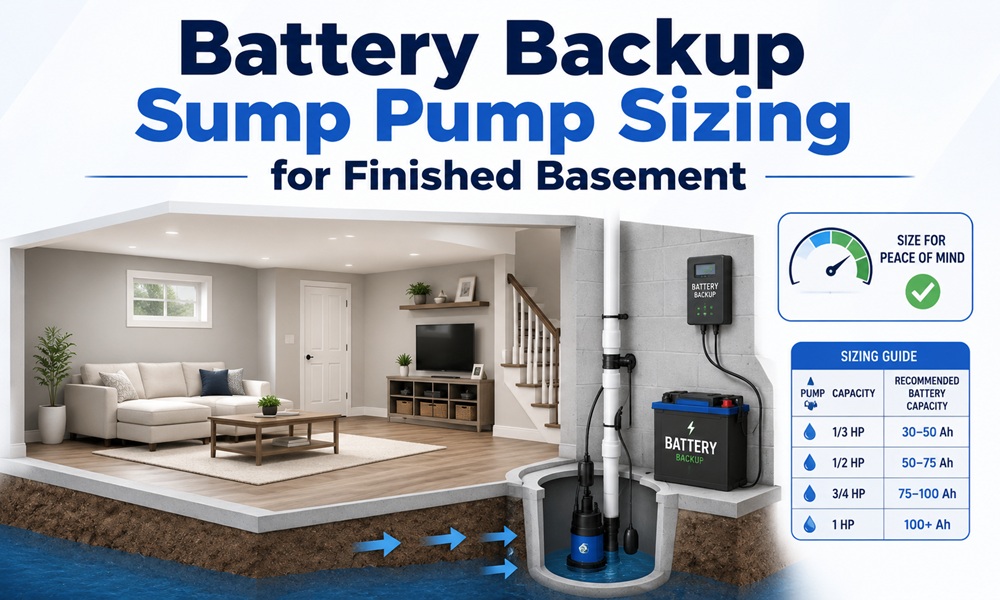
A primary sump pump only protects you when the power is on and the motor is healthy. The trouble is that the heaviest storms — the ones that send the most water into your pit — are also the ones most likely to knock out the power. That is the exact moment a finished basement is most at risk, and it is why a correctly sized battery backup is not a luxury but the core of the system. Sizing it well means two separate calculations: matching the pumping capacity to your water inflow, and sizing the battery to the length of outage you realistically face. This guide walks through both.
Why a finished basement raises the stakes
A finished basement turns a wet-floor nuisance into a four- or five-figure loss — drywall, flooring, trim, and stored belongings, plus mold that can begin colonizing in 24–48 hours. Backups fail most often during storms, exactly when the primary pump is needed most and the power tends to go out. So sizing isn’t just “buy a backup” — it’s matching capacity to your water inflow and runtime to your likely outage length. Undersize either one and the backup gives you a false sense of security that fails on the worst night of the year.
Step 1 — Match the pumping capacity (GPH)
Find your primary pump’s GPH rating on its label or the manufacturer’s spec sheet, then buy a backup rated at at least that much at your actual discharge height (head). If your primary already struggles to keep up in storms, choose a higher-GPH backup so the system does not fall behind the moment it takes over.
| Capacity rule
Backup GPH ≥ primary GPH at your discharge height (vertical lift). Capacity drops as lift increases — a pump rated 2,100 GPH at 10 ft delivers less at 15 ft. Always read the rating at *your* lift, not the headline number. |
||||
| Backup pump class | Typical GPH @ 10 ft | Good for | ||
| Light-duty 12V | ~800–1,000 | Low, steady seepage | ||
| Standard 12V (⅓ HP class) | ~1,500–1,680 | Most finished basements | ||
| Heavy-duty / high-output | ~2,100–2,400 | High inflow / storm-prone sites | ||
To find your real discharge height, measure the vertical distance from the water level in the pit up to the highest point of the discharge pipe before it runs out of the house. That number, not the catalog headline, is the capacity that matters.
Step 2 — Size the battery for runtime
Battery capacity is measured in amp-hours (Ah). A 12V deep-cycle AGM is preferred over a car battery because car batteries are built for short, high-current bursts, while deep-cycle batteries deliver moderate current for hours and tolerate repeated discharge. AGM and gel types are favored in basements because they resist sulfation, don’t corrode terminals, and have minimal gas-explosion risk in humid air.
| Runtime depends on duty cycle
Duty cycle % = pump on-time ÷ total cycle time. Example: a pump that runs 30 seconds every 5 minutes has a ~10% duty cycle. The lower your inflow, the lower the duty cycle, and the longer one battery lasts. |
Independent testing gives a useful benchmark: a fully charged 75-Ah AGM battery powered a backup pump for at least 60 hours of intermittent protection (running ~30 seconds every few minutes against modest inflow). Continuous-run figures are much shorter — the same class of pump may run only 5–8 hours nonstop on a single charge. Match the number to how your basement actually behaves:
| Battery | Group size | Intermittent protection | Continuous run |
| 75 Ah AGM | Group 24/27 | ~40–60+ hours (low duty cycle) | ~5–8 hours |
| 100–120 Ah AGM | Group 27/31 | Several days intermittent | ~8–12 hours |
| Two 120 Ah in parallel | Group 31 ×2 | Longest — multi-day outages | Roughly double single |
Detail worth knowing: as the battery drains, voltage sags and the pump weakens. In testing, after 60 hours the voltage had dropped to ~10V and the pump could no longer overcome 10 feet of lift — it was still “running” but moving no water. So your effective protection ends when voltage falls below what your lift requires, not when the battery is fully dead. Sizing in a margin above your bare minimum is what keeps the pump actually moving water late in a long outage.
Step 3 — Build it for a finished basement
- Check valve on the discharge so pumped water can’t fall back into the pit and re-trigger the pump.
- High-water alarm — ideally a Wi-Fi model that texts you when it activates or the battery is low, since you won’t hear a beep from across town.
- Charger and battery placement: mount the smart charger 3–4 feet above the floor near the sump, keep the battery in a vented plastic box on the floor, and keep both dry and accessible.
- Long-outage plan: keep a charged spare battery (or wire a second in parallel), or use a generator if outages in your area last days. A typical primary pump draws ~9 amps, so a small generator runs it easily.
Note: water-powered backups are an alternative for city-water homes — they run indefinitely on water pressure (using roughly 1 gallon of city water per 2 gallons pumped) but won’t work on a well and are banned in some water-short areas, so check local rules before relying on one.
Maintenance that keeps it ready
A backup system only helps if it works on the day you need it. Twice a year, and again before storm season, run a simple check:
- Pour a bucket of water into the pit and confirm the backup activates (unplug the primary to simulate an outage) and discharges fully.
- Check the battery charge and terminals; replace AGM batteries roughly every 3–5 years, sooner if they no longer hold a charge.
- Test the high-water alarm and confirm any Wi-Fi alerts still reach your phone.
- Clear the pit of silt and debris that could jam a float switch.
Frequently asked questions
| What size battery for a sump pump backup?
Most homes use a 12V deep-cycle AGM of 75–120 Ah (Group 27 or 31). 75 Ah covers typical intermittent storm pumping; step up to 100–120 Ah, a spare, or a generator if your outages run long. How long will a battery backup run? Anywhere from ~5–8 hours of continuous pumping to multiple days of intermittent pumping, depending on inflow (duty cycle) and battery size. Effective protection ends when voltage drops too low to overcome your discharge lift. Does the backup need to match my primary pump exactly? It should at least match the primary’s GPH at your discharge height. If your primary struggles in storms, choose a higher-output backup so the system does not fall behind when it takes over. AGM, gel, or wet-cell battery? AGM (or gel) deep-cycle is best for a finished basement — maintenance-free, corrosion-resistant, and low gassing risk in humid air. Avoid standard car (cranking) batteries, which are not built for the long, repeated discharge a sump backup demands. Should I get a second battery or a generator? If outages in your area are short, a single well-sized AGM or a spare is usually enough. If you face multi-day outages, a generator that can run the primary pump indefinitely is the more reliable plan, since batteries eventually sag below useful voltage. |