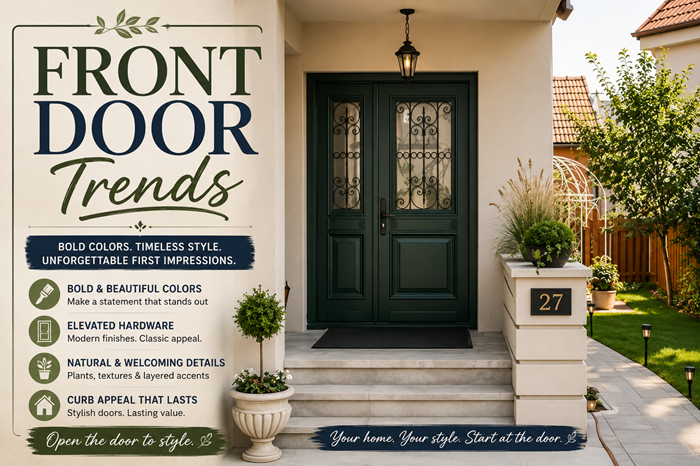
The front door used to be an afterthought — pick a color, hang it, move on. Not anymore. It’s now treated as serious architecture, complete with smart tech, oversized pivot mechanisms, and a color palette that’s leaving gray and bold red behind entirely. Here’s what’s genuinely changing at the entryway right now.
Gray, Black, and Bold Red Are Losing Their Grip
The classic front door palette is getting a real shake-up. Homeowners are moving away from cool and bold tones like gray, black, and vibrant red — gray reads as lacking warmth, black can feel harsh and industrial, and red often comes across as overly dominant. In their place: burgundy and berry shades that give a refined nod to traditional red, muted sage or olive greens for a calmer, nature-inspired feel, and deep blues that add depth without feeling cold.
Terracotta Is the Breakout Neutral
If there’s one color quietly taking over exteriors, it’s terracotta. It’s emerging as a genuine contemporary neutral — warm enough to feel intentional, versatile enough to pair with surrounding gardens and landscaping rather than fighting against them. It’s proof that “neutral” doesn’t have to mean beige or gray anymore.
Pivot Doors Are the New Status Symbol
Nothing signals a serious architectural upgrade like a pivot door right now. Unlike traditional hinged doors, pivot systems rotate on a mechanism at the top and bottom rather than swinging on a side hinge, creating a dramatic, oversized entrance with concealed hardware and minimal framing. They’re becoming a hallmark of luxury contemporary homes, allowing for wider openings and a more seamless transition between indoor and outdoor living spaces.
Smart Technology Is No Longer Optional
Integrated tech has quietly gone from novelty to expectation. App-based control, smart locks, and integrated security features are becoming standard on new front doors rather than pricey add-ons, with the design goal being to make the technology nearly invisible while still boosting convenience and peace of mind.
Texture Is Having a Real Moment
Flat, smooth surfaces are giving way to tactile design. Fluted timber, reeded glass, and brushed metal finishes are adding depth and craftsmanship to entryways, appealing to a broader range of architectural styles — from ultra-modern to warmly traditional. Designers are increasingly thinking about how a door feels under your fingers, not just how it looks from the street.
Brass Hardware Is Replacing Bright Gold
Hardware finishes are getting a quiet refresh too. Brushed brass is emerging as one of the most requested finishes, offering a softer, more refined alternative to the bright gold hardware that dominated decades past — a subtle detail that instantly modernizes an otherwise classic door.
Vertical Glass Panels Are Solving the Dark Entryway Problem
Full glass inserts are giving way to something more privacy-conscious: narrow vertical glass panels using frosted or reeded glass that let natural light in while blocking clear sightlines from the street. It’s a smart middle ground for homeowners who want a brighter entryway without sacrificing privacy or security.
Steel and Fiberglass Are Winning on Performance
Material choice is increasingly about real-world performance, not just looks. Steel remains the top pick for homeowners prioritizing security and impact resistance, while fiberglass — often finished with realistic wood-grain textures — offers superior moisture resistance, making it a favorite in humid or coastal climates.
The Bottom Line
The front door has evolved from a simple functional necessity into one of the highest-impact upgrades a homeowner can make — blending bold, earthy color choices with smart technology, tactile materials, and architecture-grade hardware. Whether it’s a terracotta pivot door with brushed brass pulls or a steel entry door built for storm season, the entryway is finally getting the design attention it deserves.